Beyond the Quote: How to Write a Fee Proposal That Wins Luxury Projects
The client experience begins long before the first fabric swatch is selected. It begins with the paperwork.
Many designers view the Fee Proposal as a simple administrative hurdle. It is often treated as a price tag attached to a promise. At Sonderpath Studio, we view it as a critical piece of brand storytelling. A well-structured proposal does not just ask for payment. It establishes trust, defines the luxury experience, and protects your creative energy.
If you find that clients push back on fees or drag projects into "scope creep," the issue likely lies in how you present your services. Here is how to structure a proposal that converts inquiries into partners.
1. The Narrative: Mirroring the Vision
A standard quote feels transactional, but a design proposal should feel relational.
Your document must start by proving you were listening. In our templates, we prioritise a dedicated Project Overview section immediately following the welcome note. This is where you reiterate the client's specific desires, such as preserving "classic architectural elements" or achieving a "modern yet timeless aesthetic".
By documenting their goals upfront, you validate their vision. You are not just selling design hours; you are selling a solution to their specific problem.
2. The Roadmap: Services vs Deliverables
Confusion is the enemy of a signed contract. A common mistake is listing what you do (Services) without listing what they get (Deliverables).
To rank as a professional authority, your proposal needs to separate these clearly.
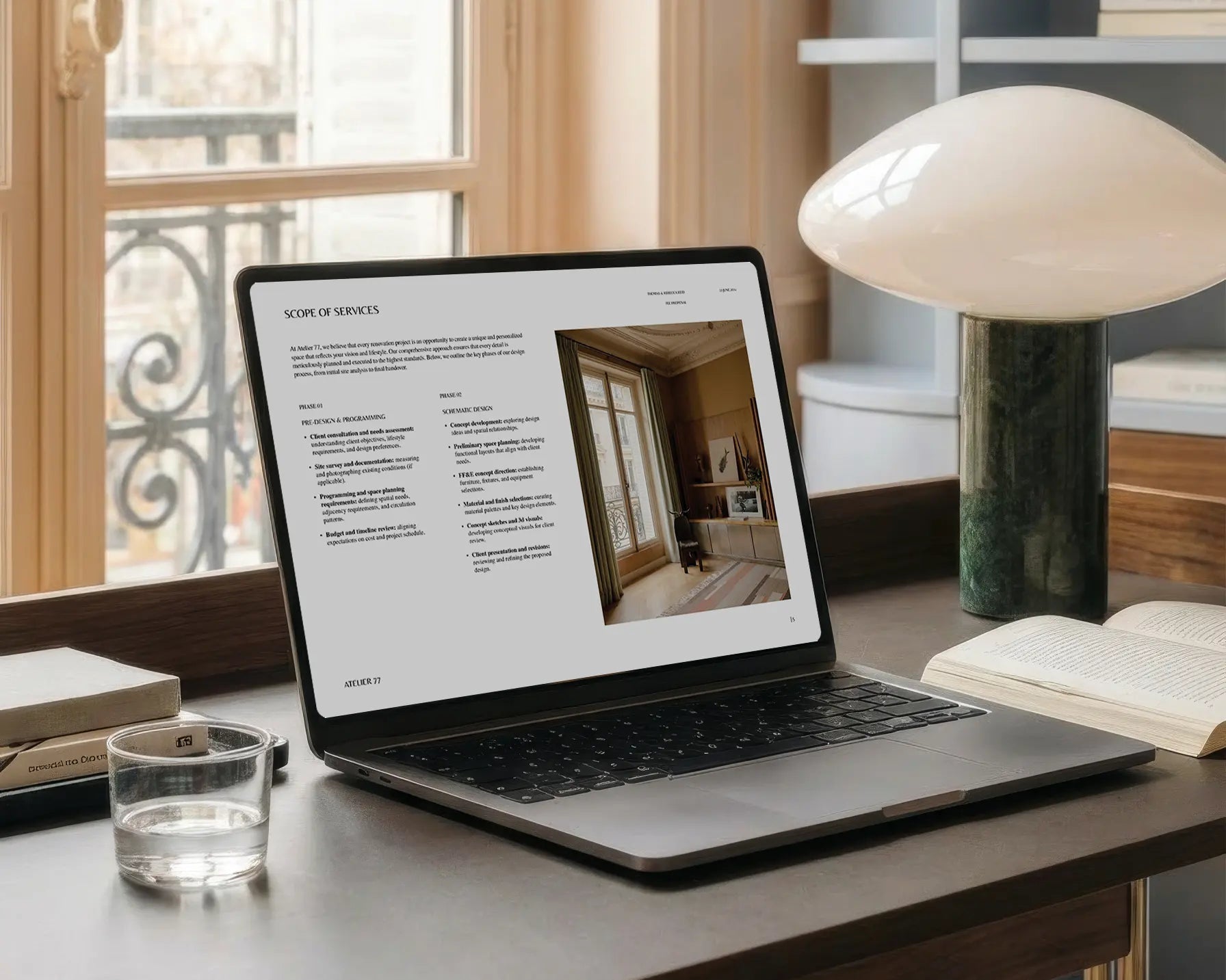
- The Phases: Break your timeline into clear stages, from Pre-Design & Programming through to Site Coordination & Installation.
-
The Deliverables: For every phase, list the tangible outputs. Do not just say "Concept Design." Specify that they will receive "mood boards," "material & finish selections," and "3D visuals".
Clients are more willing to sign off on a significant investment when they can physically see the list of documents, drawings, and schedules they will receive in return .
3. The Boundaries: Protecting Against Scope Creep
The most successful studios are those with the clearest boundaries. "Scope creep" usually happens because the exclusions were not written down.
Your proposal functions as your first line of defense. It must include a Scope Conditions & Exclusions section. Be explicit about what is not included in your fee:
-
Permit applications and building regulations
-
Procurement logistics and storage charges
-
Specialist consultants like structural engineers
Furthermore, clearly define your Revision Policy. We recommend stating clearly that "two rounds of revisions" are included per phase. You should also clarify that subsequent revisions "will be billed at an hourly rate". This empowers you to charge for extra work without guilt.

4. The Experience: Communication Protocols
High-end clients value communication as much as the design itself. However, you want to avoid the boundary-blurring nature of unstructured messaging.
One detailed feature we include in our templates is a dedicated Communication page. This sets the rules of engagement before the project starts. It outlines:
- Point of Contact: Identifying their dedicated manager
- Feedback Channels: Explicitly stating how feedback should be delivered ensures instructions are not lost in casual texts
- Updates: Promising "regular updates" and "milestone notifications" puts the client at ease so they do not feel the need to micromanage
5. The Investment: Transparency
When you reach the Fee Summary, clarity is key. Whether you charge a fixed fee or hourly, break it down by phase so the client understands the workflow .
Equally important is listing Additional Expenses upfront. Clients dislike surprise bills. By listing potential costs for "shipping," "printing," or "third-party consultants" on the proposal, you demonstrate transparency and financial maturity.

A fee proposal is more than a request for payment. It is a sample of your organisation, your aesthetic, and your professionalism. If your proposal looks messy, the client assumes the renovation will be messy.
Creating a document of this depth from scratch for every inquiry is inefficient. The most profitable studios use a standardised, beautiful framework that allows them to write the narrative without reinventing the legalities.
Shop our Interior Design Fee Proposal Templates, complete with pre-written scope of work clauses, deliverables lists, and terms of service.